
From Helene Volunteer to Solar Partner: Mack's Two-Year Journey With Footprint Project
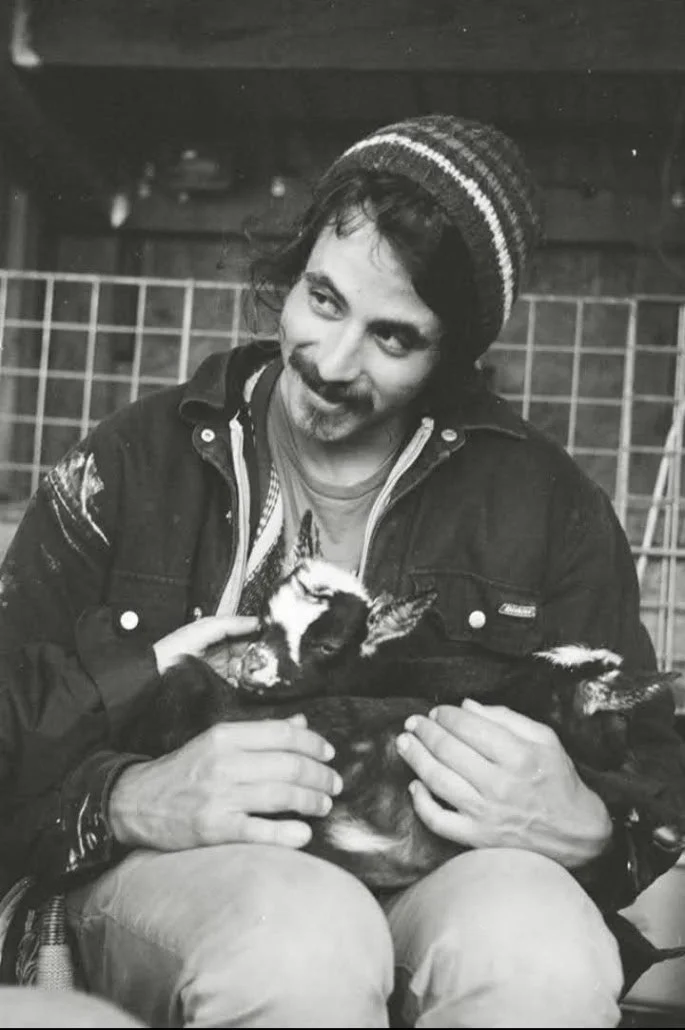
Two years ago, in the chaotic days after Hurricane Helene, Mack was sent to Mars Hill to drop off a trailer of solar panels. He had never heard of Footprint Project. By the end of the day, he was in a field, testing donated Tesla Powerwalls with a car jump starter, and he stayed on to volunteer for several days. Today, Mack is a crew lead at Rhino Renewables, a local solar company working with Footprint Project to install rooftop solar and battery storage at Beacon of Hope, a food assistance and thrift store nonprofit in Marshall. We sat down with him to talk about that first day after the storm, what keeps him in Western North Carolina, and how to survive a 165-degree roof in September.
INTERVIEWER
What's your name and what's your role on the crew?
MACK
Well, my name is Mack. I guess my full name is McKinnon, but I go by Mack. I'm one of the crew leads over at Rhino Renewables. It's a really good team of people. A lot of my friends who left other local solar companies went there, so we've got a really great, small thing going. It's more mom and pop, so sometimes I help out our electricians too. But most of the time I'm leading a crew, and at the Beacon of Hope solar install I was helping put panels down and string everything together. It felt good. It's a pretty nice day too. A little hot.
INTERVIEWER
Cool! Yeah, it's been off and on pretty hot lately. Hot September so far.
MACK
Yeah. And it'll be like 10, sometimes even 15 degrees hotter up there, especially on those silver metal roofs. You'll get sunburn on the bottom of your nose in July because it reflects the sun right at your face. The surface of that roof is like 165. Everything's just kind of hot coffee, and there's pretty much a wall of heat. So it was wonderful to work on the Beacon of Hope installation in September when it wasn’t as hot.
INTERVIEWER
How do you guys stay cool up there?
MACK
A great big sun hat from a garden store works really well. I like wet bandanas too. We do a lot of residential jobs at people's houses, and around here you'll meet cool people that way, and you're just kind of like, "Hey, I'm going to take a hose bath." I'm going to just be soaking wet. That would be my mid-July tactic.
You'll drink like three gallons of water in the summer! It's a little bit insane. And I jump in a lot of creeks in the evening to regulate my body temperature. I'm a big creeks fan! But on-site, probably cold bandanas and a good attitude.
INTERVIEWER
I was talking with Jamie Trowbridge recently. He mentioned that you volunteered with Footprint Project before.
MACK
Yeah, it was kind of random, if you want the whole story.
INTERVIEWER
Definitely!
MACK
Before, I was doing wilderness therapy, and the company I was working for wasn't good. And so I was just like, "I'm getting out of here." So I left that job and I was managing a gate house in Pisgah Forest for a recreation area, and it was powered by solar. After that, I got interested in solar and Sugar Hollow Solar, which is a local solar company.
Basically, Sugar Hollow trained me to do solar, and when I joined them, I was working with a lot of people who later became Rhino Renewables people.
So I was working for Sugar Hollow when the storm hit, and I guess somebody they knew had partnered with Footprint Project. I don't know exactly how, but one day we were taking a trailer full of solar panels up to Mars Hill. It was right after the storm, so there weren't any straightforward ways to get there. We couldn't take the highway because it was all blocked off, so you had to go on these little gravel side roads, and we sort of knew the terrain.
That was my first day in the city after the storm, because we couldn't get there for a while. I'm in Black Mountain, so I was a little bit to the east. [I-40] was flooded and impassable in Swannanoa, with RVs or something [that] had floated into the middle of the road on old 70, and there had just been a landslide to the east. So you couldn't get there from any direction, and I couldn't get into the city for about a week.
When I did, it was pretty chaotic. Sugar Hollow had lost their entire warehouse, so we all regrouped and salvaged what we could. Through a major bit of luck, they'd managed to get another warehouse right before the storm. They're all really good people over there. Some of the people I work with now used to work there.
Then someone told me they needed some panels up in Mars Hill. I'd never heard of Footprint Project, but I was sort of dispatched to go up there, and I met everybody. They had a lot of stuff going on.
A lot of people had donated Tesla Powerwalls, and those don't have an indicator for when they're charged, which is sort of a design oversight. They're designed to be plugged into a wall on the side of a house. You come by with a phone, scan a barcode, and their lovely little installation platform tells you how charged the battery is. But Footprint Project had this shipment of them that had just been dropped by some person, some agency, into the middle of a field, and it was impossible to tell if the people who donated them had charged them.
And just by happy luck, a guy had told me before the storm that you could open the battery up and jump it at this little part in the bus bar with one of those battery bank jumpers you use for your car. I happened to mention that to somebody who was overseeing the batteries, and they were like, "Get this guy one of those jumpy things." So I just started jumping batteries in the middle of a field to figure out if they were charged or not. I don't know if I was supposed to be up there volunteering, but it was a bit chaotic at that point.
I don't think I had cell service to call Sugar Hollow, but I got through at some point and I was like, "Hey, I'm up here just helping these Footprint people out." And they're like, "That's cool. Yeah, we talked to them. You can volunteer there for the next three days or something." So that was how it started.
I did a couple other things with Footprint Project too. They were all really cool and pretty knowledgeable. There was one day of just rolling battery banks into an elder care home to power defibrillators and fridges and such. I guess water was still out citywide at that point, and there were little parts of East Asheville that still didn't have grid [power].
INTERVIEWER
You kind of explained what drew you to solar, but you said you were a therapist before.
MACK
No, I was doing outdoor adventures. And it kind of transitioned into wilderness therapy, but it was just not really my speed.
The full, crazier story is that I was in a traveling phase in my 20s, after college. I drove with my best friend down to Mexico, and then I taught English in Spain because of somebody I met in Mexico. When I came back to the United States, I had a visa to teach English in Chile. I was set to go right before COVID, so I probably would have had to come back anyway.
Then my best friend got a permit to do a trip down the Grand Canyon. We had all kind of half grown up at this outdoor adventure camp, and a bunch of us went out for permits to raft the whole Grand Canyon at the same time. So we had this big group, but we wouldn't see each other for days. The trip took like 23 days, and every few days we'd see a raft filled with our friends, and we'd trade eggs for beers.
And I was at the bottom of the Grand Canyon, and I was like, "You know what? I'm gonna stay in the United States. I don't know why, but I'm just gonna do it."
Then this friend in a raft behind us, who had a whole cooler of beer, flipped. It was all Asheville beers. In order to not litter in the Colorado, and in the interest of just friendship and brotherhood, we camped out on a beach and caught all the beers bobbing down the river in a bend ahead of them, so we could restock their raft.
I'd heard of Asheville from [whitewater] kayaking in Maryland. We were all over West Virginia, Pennsylvania, and western Maryland, and Asheville was the next cool spot southeast of there. People kayak down there. And before the Grand Canyon, I'd done an adventure trip in north Georgia with a really cool school of kiddos, hiking and climbing and caving and biking. We passed through Asheville, and I was like, this place is cool. Maybe someday I'll go there.
So when all those little Asheville beers came a-floating down the river, I was like, "I'll just go to Asheville." I went, found a random job, and then COVID hit and I stayed here.
Solar was kind of my way to stay in this area. I love it here. It's sort of a continuation of the mountains I saw in the distance growing up. I always wanted to get to this spot, and solar has helped me do that while also feeling pretty good about what I do.
Two years after Helene, Mack is still showing up for Western North Carolina, this time on a rooftop in Marshall instead of a field in Mars Hill. We're grateful to him and the Rhino Renewables crew for helping Beacon of Hope keep the lights on for the community it serves.
